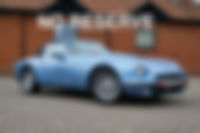




1992 TVR V8S

33 Bids
9:00 PM, 08 Oct 2019Vehicle sold
Sold for

£7,700

Background

The TVR S was launched at the 1986 British International Motor Show (sounds quaint now, doesn’t it?). As Peter Wheeler’s first big project, he could be forgiven if he’d come out with a bit of a duffer but the TVR S was such a sensation that 250 people pre-ordered one.  

Which meant it was rushed into production, to the detriment of reliability; a glassfibre body sitting on top of a steel chassis has the potential to introduce all sorts of electrical quirks, even without rushing it out to quiet a baying customer base.

Its performance, and almost telepathic handling, are the direct result of careful engineering and a sub-1,000kg kerbweight. We Brits might not be good for much these days but we couldn’t half engineer a cracking lightweight sportscar back then.

The TVR V8S is fitted with a 4.0-litre Rover V8 engine with gas-flowed heads, a high-lift camshaft, a higher compression ratio than usual, a free-flowing manifold, and a remapped engine management chip. This means it boasts 240bhp and 270lb/ft, which is quite a lot in a car that weighs the square root of bugger all.

Performance is, er , terrifying. Even moving it around our premises causes the head honcho, no slouch behind the wheel and a racer of no little talent, to break out the Pampers. The limited-slip differential and wider track (courtesy of different suspension wishbones on the front and revised trailing arms at the rear) help but when you’re driving a car with no electronic aids, a 0-60mph time (yep, we still used imperial, back-in-the-day) of under five seconds means that it’ll light up the rear tyres at almost any speed and with little provocation.

In fact, the TVR V8S’s OZ alloy wheels, along with its twin, swept-up exhaust system and asymmetric bonnet vent (which faces the driver on the V8…) are visual cues that fire us straight back to the early nineties, the sweet-spot era where old school looks fuse seamlessly with modern usability: if cars from the sixties and seventies demand a certain commitment to be able to enjoy classic motoring - and the noughties onwards mean sealed-unit inaccessibility - cars from the nineties give near-perfect reliability and everyday usability.

And when they do break, you can work on them with nothing more than simple hand tools and an enquiring mind. And a Haynes manual and a multimeter, obviously.

  • SDLDSN4P8NL011626
  • 84000
  • 3947CC
  • Manual
  • Metallic sky blue
  • Light grey leather

Background

The TVR S was launched at the 1986 British International Motor Show (sounds quaint now, doesn’t it?). As Peter Wheeler’s first big project, he could be forgiven if he’d come out with a bit of a duffer but the TVR S was such a sensation that 250 people pre-ordered one.  

Which meant it was rushed into production, to the detriment of reliability; a glassfibre body sitting on top of a steel chassis has the potential to introduce all sorts of electrical quirks, even without rushing it out to quiet a baying customer base.

Its performance, and almost telepathic handling, are the direct result of careful engineering and a sub-1,000kg kerbweight. We Brits might not be good for much these days but we couldn’t half engineer a cracking lightweight sportscar back then.

The TVR V8S is fitted with a 4.0-litre Rover V8 engine with gas-flowed heads, a high-lift camshaft, a higher compression ratio than usual, a free-flowing manifold, and a remapped engine management chip. This means it boasts 240bhp and 270lb/ft, which is quite a lot in a car that weighs the square root of bugger all.

Performance is, er , terrifying. Even moving it around our premises causes the head honcho, no slouch behind the wheel and a racer of no little talent, to break out the Pampers. The limited-slip differential and wider track (courtesy of different suspension wishbones on the front and revised trailing arms at the rear) help but when you’re driving a car with no electronic aids, a 0-60mph time (yep, we still used imperial, back-in-the-day) of under five seconds means that it’ll light up the rear tyres at almost any speed and with little provocation.

In fact, the TVR V8S’s OZ alloy wheels, along with its twin, swept-up exhaust system and asymmetric bonnet vent (which faces the driver on the V8…) are visual cues that fire us straight back to the early nineties, the sweet-spot era where old school looks fuse seamlessly with modern usability: if cars from the sixties and seventies demand a certain commitment to be able to enjoy classic motoring - and the noughties onwards mean sealed-unit inaccessibility - cars from the nineties give near-perfect reliability and everyday usability.

And when they do break, you can work on them with nothing more than simple hand tools and an enquiring mind. And a Haynes manual and a multimeter, obviously.

Overview

In the same family for the past 15 years, the owner bought this lovely metallic blue TVR V8S from his father-in-law, who sadly passed away shortly thereafter. He had long admired the car – as had his father-in-law, who owned a succession of TVRs from an early age and was never without one – and it entered his hands with an emotional attachment that means it is hard for him and his wife to let it go.

But, he’s a pragmatic man, and understands that while it holds a place in their hearts, they simply don’t have the time to get on top of its usual-for-the-model electrical quirks, much less use it as regularly as it needs to be used; it was his father-in-law’s daily driver for many years and this was a regime that helped keep it running well and fully operative.

So, he knows that the time has come to let it go to another enthusiast who will come to love it as much as his family have done. This, we can understand; nothing that has passed through our hands has generated more interest in the office in firing it up and shuffling it around. As the owner’s manual puts it, this is a highly unsocial car – and while it isn’t perfect, we utterly adore it and think you will too.

It is being offered with no reserve, so will sell from the very first bid.

Exterior

The glassfibre bodywork means no worries about rust but that aside the TVR is in good shape. It is believed to have had a full professional respray approximately ten years ago, and still looks good. Lovely little details abound, like the embossed ‘TVR’ on the chrome door handles, and the asymmetric bonnet vent.

The panels line up pretty well for what is essentially a hand-crafted British sportscar too, and the doors open and close easily, although the alignment of the driver’s door could do with tweaking to make it perfect.

The three-piece roof is reasonably new but the weather has taken its toll, so the fabric covering is in good, but not great, condition.

The OZ alloy wheels are in good shape though having been professionally refurbished three years ago. They will need some new rubber fitted to them as the current tyres are starting to look a bit old.

Work that may need to be carried out is the nearside bonnet catch, although we have been told this is sorted for the short term, plus the need to rectify the chips, scuffs and dings that it wears with pride. The front offside indicator lens is cracked, and there are some stress cracks on the rear, which are indicative of a low-speed bump. If that is the case, then it was only minor as it appears to have caused only cosmetic damage.

Of course, as the rat look is in you could fettle the mechanicals and interior and leave the bodywork in its current condition; after all, it’s not going to rust and no-one is going to be able to get close enough to see it properly while it’s moving...

Interior

The interior isn’t as pretty as the exterior but it gets better the closer you look. So, the grey leather seats might be creased and patinated but they aren’t holed or showing excessive wear and still feel great to sit in.

The dashtop hasn’t cracked in the sun like so many do, and the leather-trimmed switch panel and centre console is in great shape, as are the door cards.

The TVR-branded dials and switches are all present, along with a JVC headunit and matching speakers. The tiny three-spoke, leather-trimmed steering wheel is good too and feels lovely in the hand, as does the gorgeously rotund alloy gearknob.

The carpets in the cockpit are in good condition but could do with deep cleaning. Those in the boot look good too, although it’s hard to be certain as they aren’t currently fitted and are rolled up in the luggage compartment.

As for the bad bits, well, it’s got the usual TVR faults so only a few of the gauges work, the driver’s seatbelt can be a bit temperamental when it’s furling and unfurling, the stereo is currently unplugged (largely because you can’t hear it when the car is running anyway…), the electrically operated windows operate when they feel like it, the door mirrors don’t adjust, and the immobiliser is disconnected and could do with being removed properly to forestall future problems.

There is probably more, but the key thing to take away from this is a) if you’re handy with a multimeter most, if not all, should be easy to sort out, and b) they’re all like this anyway.

Mechanical

The ride is the correct amount of firmness (more steel girders than comfy pillows), and the gearchange needs a firm hand, but that’s how they were designed and how they left the factory. It’s a car that rewards a firm hand, and by God it needs one.

The engine starts first turn of the key - the owner SORN’d it for more than a year, and it started first time - and the engine and exhaust work in unison to make a noise like a symphony of Greek gods orgasming. It revs well, and has more than enough performance for anyone this side of Lewis Hamilton. It also steers and brakes as it should, which is to say very well.

Problems, it’s got but a few. It overheats if you leave it ticking over for a long time, and the handbrake doesn’t work. The engine bay is a bit scruffy too, but that would be a fun job rather than anything too onerous.

Oh, and it’s had a new alternator recently, plus new rear discs and pads only a handful of miles ago in 2016. Other recent work is a speedometer repair in 2016 (although it still doesn’t work as it should), and a new fuel tank sender in 2017, along with a replacement gauge; neither sorted the problem of false readings though.

It also had a new chassis a decade ago when it was resprayed. (see new photos in the gallery)

History

Despite its flaws, the TVR passed its MOT in September with only minor advisories; this means you’ve got eleven months to enjoy it until you’ve got to face the tester’s scrutiny again, which is plenty of time to get her ship-shape.

The TVR comes with three keys, plus some invoices and old bills to support the care it has received over the past couple of years, and a book on the TVR S.

If you’d like to inspect the car prior to placing a bid – something we would encourage – then please contact us to arrange an appointment.

Summary

You might have formed the opinion that this is a bit of an old dog of a project. If so, while we understand completely, you are wrong. It isn’t. With a new-ish chassis and an engine that is the very definition of rude good health, we have adored every single test-drive we’ve taken in it - and there have been a couple more starts and maneuvers than were strictly necessary, such is the love in the office for it.

Fair enough, it may have more than the average ‘Sunday-project’ jobs to do, but it’s a TVR so you don’t expect perfection do you? And it sounds better than just about anything we’ve ever sold, it’s worth the price of entry for that alone. Seriously, you might think you know what a four-litre Rover V8 sounds like in a TVR but you don’t. You really don’t. And we’ll be happy to host you here so you can experience for yourselves just how glorious it sounds. 

It drives well, too. If you despair of EU testing cycle-optimized family cars with inappropriately small engines and gearbox ratios designed for economy rather than performance, this is your antidote; honestly, no matter what your woes, a quick blast in this consigns them to the back of your mind mainly because simply keeping it pointing in a straight line will occupy every ounce of spare brain capacity, leaving no room for anything else.

But yes, it does need some fettling but the main bits are all there and think how satisfying it’s going to be, tucked away in your garage on those long winter evenings fiddling and fettling and firing her up every now and then. Just keep the door open though, won’t you? We can’t think of a more efficient way of filling your lungs with vast quantities of carbon monoxide than this…

It’ll be cheap, too. Being offered with no reserve, it’ll sell from the very first bid – and at a time when good ones fetch an easy five-figure sum, you’ve got the chance to add value at every step.

Viewing is always encouraged, and this car can be seen here at The Market HQ in Abingdon; to arrange an appointment please use the ‘Contact Seller’ button at the top of the listing. Feel free to ask any questions or make observations in the comments section below, or try our ‘Frequently Asked Questions’.

If needed, please remember we have a network of trusted suppliers we work with regularly and can recommend: Classic & Sportscar Finance for purchase-financing, Thames Valley Car Storage for storing your car, AnyVan for transporting it, and Footman James for classic car insurance.

BORING, but IMPORTANT: Please note that whilst we at The Market always aim to offer the most descriptive and transparent auction listings of any auction, we cannot claim they are perfect analyses of any of the vehicles we have for sale. While we use our trade experience to assess every car that comes through our hands (and between us we have bought hundreds of classic cars over the years for our personal use…) we are fallible, and our assessment of a car may contrast with that you might form yourself.

This is why we offer a far greater opportunity for bidders to view, or arrange a professional inspection on their behalf of, each vehicle prior to bidding than any traditional car auction, and we will never stop encouraging bidders to take advantage of this by coming to see it in person.

That said, we do take a good look at the vehicles delivered to our premises for sale, but this only results in our unbiased personal observations, not those of a qualified inspector or other professional, or those formed as a result of a long test drive.

Additionally, please note that most of the videos on our site have been recorded using simple cameras which often result in 'average' sound quality; in particular, engines and exhausts notes can sound a little different to how they are in reality.

About this auction

Seller

Private: bill deeker


Viewings Welcome

Viewing is strongly encouraged, and is strictly by appointment. To book one in the diary, please get in contact.

preview-BE614035-DC77-4540-8C0C-7C837B57E941.jpg?optimizer=image&width=650&quality=90 image

Thinking of selling your TVR