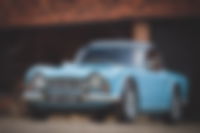




1962 Triumph TR4 (V8)

31 Bids
9:02 PM, 21 Jul 2020Vehicle sold
Sold for

£29,250

Background

Ask a motoring enthusiast to name some of the greatest British sports cars of the 1960s, and it’s likely that the elegant yet purposeful Triumph TR4 will be near the top of the list. Now question him or her on one of the best engines of the same period, and the wonderfully smooth and flexible Daimler V8 (as found in that marque’s SP250 ‘Dart’) will undoubtedly figure prominently too. If only both had been combined together, what a car that would be…

Triumph’s TR range was born in 1953 with the TR2. And although the curvaceous, Tarmac-hugging machines that developed from this original - the TR3 and TR3A - proved Triumph’s sporting credentials during the 1950s, it was with the Giovanni Michelotti-designed TR4, TR4A and TR5 of the following decade that the sporty series arguably reached its zenith. The sharp and imposing lines showcased an Italian sleight of hand that made the cars among the most handsome British machines of the 1960s, while tweaks to the suspension, brakes and mechanics - most notably a jump from four-cylinders to six for the TR5 - kept them abreast of their competition.

One of those rivals - albeit significantly more expensive - was Daimler’s SP250 sports car. Initially named the Dart - until trademark holder Chrysler objected - the jewel of this glassfibre open two-seater was its compact Edward Turner-designed hemi-head V8 engine. At a time when most British manufacturers had yet to embrace V8 technology, it gave the small Daimler a remarkable level of refinement and performance that was later carried over to the Daimler 2 1/2-Litre variant of the Jaguar MkII saloon. Although the SP250 was something of a sales disappointment, thanks to quality issues with early cars, there was rarely anything but fulsome praise for its V8 heart.

Turner’s V8 only appeared in a handful of Daimler models, but deserved greater exposure. Which is precisely what the mastermind behind this V8-powered TR4 felt when he dreamt up its transformation.

  • CT3929L
  • 00075
  • 2548
  • Manual Overdrive
  • Powder Blue
  • Blue Leather

Background

Ask a motoring enthusiast to name some of the greatest British sports cars of the 1960s, and it’s likely that the elegant yet purposeful Triumph TR4 will be near the top of the list. Now question him or her on one of the best engines of the same period, and the wonderfully smooth and flexible Daimler V8 (as found in that marque’s SP250 ‘Dart’) will undoubtedly figure prominently too. If only both had been combined together, what a car that would be…

Triumph’s TR range was born in 1953 with the TR2. And although the curvaceous, Tarmac-hugging machines that developed from this original - the TR3 and TR3A - proved Triumph’s sporting credentials during the 1950s, it was with the Giovanni Michelotti-designed TR4, TR4A and TR5 of the following decade that the sporty series arguably reached its zenith. The sharp and imposing lines showcased an Italian sleight of hand that made the cars among the most handsome British machines of the 1960s, while tweaks to the suspension, brakes and mechanics - most notably a jump from four-cylinders to six for the TR5 - kept them abreast of their competition.

One of those rivals - albeit significantly more expensive - was Daimler’s SP250 sports car. Initially named the Dart - until trademark holder Chrysler objected - the jewel of this glassfibre open two-seater was its compact Edward Turner-designed hemi-head V8 engine. At a time when most British manufacturers had yet to embrace V8 technology, it gave the small Daimler a remarkable level of refinement and performance that was later carried over to the Daimler 2 1/2-Litre variant of the Jaguar MkII saloon. Although the SP250 was something of a sales disappointment, thanks to quality issues with early cars, there was rarely anything but fulsome praise for its V8 heart.

Turner’s V8 only appeared in a handful of Daimler models, but deserved greater exposure. Which is precisely what the mastermind behind this V8-powered TR4 felt when he dreamt up its transformation.


Video

Overview

When new in 1962, this TR4 made its way over the Atlantic to the USA, as so many of its kind did. Also like so many of its siblings, it later returned to its homeland once it had achieved thoroughbred classic status. In the case of this example, its repatriation was in March 2016, being acquired by a long-term Triumph enthusiast. ‘Dad was looking to create the perfect TR4,’ says the vendor, the son of the creator. ‘For him, that also meant transplanting in the fantastic V8 engine from the Daimler SP250. Dad talked about the fact the V8 SP250 engine had a lower centre of gravity than the original in-line four-cylinder unit so his vision was a more powerful TR4 but not at the expense of handling which would be enhanced with the lower centre of gravity of the Daimler V8.’

Over the next two years, no expense was spared on a full professional body, engine and gearbox restoration. The vendor reckons there’s around £80,000 of receipts, with ‘probably another £10,000 not recorded’. Unfortunately, his father fell ill and passed away before his ideal TR4 was totally completed; his son had the rest of the work finished. The estimate is that the car has had in excess of 1000 hours of professional effort lavished on it.

The result is a classic that genuinely merits the description ‘unique’. We’ve not come across another Daimler V8-engined Triumph TR before, and the professionalism of the installation and the restoration can be seen from our many photos. While traditionalists might decry the loss of the ‘proper’ 2138cc Triumph motor, this car offers more power - 140bhp instead of 104bhp - and improved road manners, as well as a much smoother power delivery. Yet aside from the Minilite wheels and improved seats, it still looks totally standard on the outside, and with around 150 miles covered since its rebirth was completed, it’s essentially a new car. In more ways than one. The reserve of £21,000 to £35,000 is a small proportion of what has been spent in recent years.

Exterior

Powder Blue was an original shade for the Triumph TR4, and quite a popular one, for it showed off Michelotti’s deftness to good effect. It’s complemented by a black hood. As a fresh restoration, everything is still in impeccable order; the paint is excellent, the soft-top unmarked, and all panel gaps totally straight and even. ‘Better than new’ may be an oft-over-used phrase, but in this case, it’s completely justified. They did not put ‘em together nearly this well at the factory.

For those who absolutely have to nit-pick, there are a couple of minor drips of paint apparent in places such as alongside the offside rear light and in front of the passenger rear wheel arch. But the overall impression is of a frankly superb car, as you’d expect of any vehicle where the work by NDM Body Engineers in Devon easily surpassed £10,000. NDM is a world renowned expert in body repair and manufacture and supply AC Cobra 427 chassis and bodies direct to Shelby, as well as specialise in TR, Porsche 550 and Jaguar C Type projects. Needless to say, there’s not the slightest hint of rust anywhere; not even on the fixtures.

The eye for detail has extended through to the chrome and other brightwork, which is as new. It appears from all the paperwork that, if something was worn or scruffy, it was replaced. Simple as.

The wheels are 15in Minilites clad in 175/70 HR15 86H Vredestein Sprints. Both wheels and tyres are new; there’s not even any scuffing to the tyres, let alone the Minilite rims. Behind the (front) wheels, the ventilated discs and calipers are so clean, they almost sparkle.  

Interior

As you’d expect, this TR is just as good on the inside as it is outside, although slightly more artistic licence is evident to take the car a little further away from standard spec than is the case with the exterior.

Most obvious are the Mazda MX-5 seats, although even a Mazda aficionado might be hard-pressed to recognise their origins. Such seats are often chosen for classics because of they’re narrow enough to fit nicely, but are more comfortable, supportive and safe than what they replace. Here, they’ve been retrimmed in blue leather, including the headrests. The update has been sympathetically done so it blends in with the rest of the car, but a new owner will no doubt appreciate the additional comfort. The upholstery is factory-fresh, as are the carpets.

Surprisingly, the temptation to fit a traditional Triumph wooden dashboard has been resisted - this TR4 retains its original look of a white metal fascia trimmed with black vinyl. There are some areas - such as around the centre switchgear - where the vinyl is a little loose and could be improved. No radio is fitted; there’s a bolted-on blanking plate in the space it would normally occupy under the middle of the dash. All gauges look brand new although, intriguingly, the speedometer and rev counter have been transposed from their usual positions, with the speedo to the right of the steering column rather than on the left. The odometer shows just 75 miles; in reality, the car has covered a mere 150 miles or so, but did stop working en route to The Market’s Abingdon premises. It’s a reminder that this car has been so recently completed that there are likely to be some teething issues which will need to be sorted out - after all, this is a car that has yet to be run-in.

The boot hasn’t been trimmed out, which allows a greater appreciation of the quality of the work here. A stainless steel fuel tank has been fitted. The spare wheel is like the rest of its rubber buddies; spotless.  

Mechanical

Of course, the biggest departure from Triumph norm is to be found under the bonnet, in the form of the Daimler V8 engine. Considerable fabrication work was done to the engine bay and transmission tunnel, in order to fit the V8 and gearbox neatly and effectively. However, if you’re unfamiliar with how a TR4 engine bay should look, it would be difficult to tell that this wasn’t how the car emerged from Coventry almost 60 years ago. The installation is extremely professional with neat edges etc; the Daimler V8 looks entirely at home in the spot once occupied by an engine with half its number of cylinders and about two thirds of its power. There’s no grime, dirt or any leaks apparent, and the wiring and pipework fitment has been been done to a very high standard.

The V8 and gearbox were sourced at the same time as the car returned from the USA and completely rebuilt while other work continued on the vehicle. As it turned out, the transmission still had a few issues after this, so had further work done to rectify the issues that remained. This was completed by TR Enterprises in December 2019. An overdrive is fitted and was overhauled as part of the renovation.

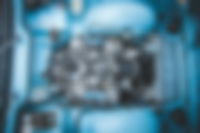
Underneath, the TR4 retains its Powder Blue finish rather than being comprehensively coated in underseal, although some chassis areas and mechanical components have received protective black paint. The job looks to have been carried out with the same level of care and attention as the rest of the bodywork, and it’s all very clean and utterly devoid of corrosion. A custom-made stainless steel manifold and exhaust system is a notable feature.

The vendor drove the car from Nottingham to us for the auction during which it ran very well, a brave move perhaps as it has travelled so few miles. On our test drives the car idles beautifully smoothly and the whole car feels tight and drivable. We have noted a slight misfire and found one or two of the plug leads are loose in their Champion plug caps.

History

You could happily spend a whole day, or even longer, ploughing through all the paperwork that accompanies this TR4. There’s a huge amount, with much of it from reputable specialists such as Rimmer Bros, Revington TR, Holden Vintage and Classic etc. While there’s some history from its life in the USA, it seems that absolutely everything has been kept since it came back to the UK - and that’s the important stuff, since the car was completely rebuilt once on home soil again. As noted previously, the bills from 2016 run into the many thousands - if it needed doing, it seems to have been done, period. Over four years, this car has had an absolute fortune spent on getting it to its current lovely state. The current MoT runs to 30 June 2021.

Summary

This is a very special car, and one-of-a-kind, thanks to its engine enhancement. It is also fabulous and enchanting. All the expensive and hard work has already been done; a new owner will be able to just buy and enjoy, albeit there will probably be some inevitable teething issues to resolve, inevitable in the running-in phase. Whoever buys it will be getting a classic that combines Triumph TR sportiness and appeal with Daimler refinement and sophistication. That’s a heady combination – and one that will require many conversations with classic aficionados at the pub!

The wide estimate of £21,000 to £35,000 and even more competitive reserve reflect a classic that is highly individualistic and distinctive. This was somebody’s idea of what their perfect Triumph TR4 should be and, we have to say, their vision was an inspired one. While this car will be a talking point at shows and other events, far more important will be the driving experience and satisfaction it offers its owner. And a Daimler V8 rarely disappoints, especially not when it’s surrounded by something as desirable as a Triumph sports car.

Viewing is always encouraged, and this particular car is located with us at The Market HQ near Abingdon; to arrange an appointment please use the Contact Seller button at the top of the listing. Feel free to ask any questions or make observations in the comments section below, or try our ‘Frequently Asked Questions’.

About this auction

Seller

Private: richardm


Viewings Welcome

Viewing is strongly encouraged, and is strictly by appointment. To book one in the diary, please get in contact.

preview-0788FD4F-B5B5-45B7-8B1B-72DFAFDF8AC1.jpg?optimizer=image&width=650&quality=90 image

Thinking of selling your Triumph