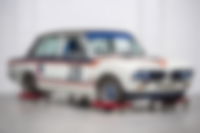

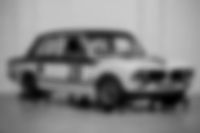
1974 Triumph Dolomite Sprint "Works" Race Car

7 Bids
7:30 PM, 04 Mar 2021Vehicle sold
Sold for

£51,000

Background

We don’t think we’re being unduly harsh when we say that the Triumph Dolomite was a dull but worthy car designed for painless family motoring rather than high-stakes thrills.

Launched as a 1.9-litre car in 1972, even the folk at the Triumph factory admitted even its 91bhp endowed it with little more than adequate performance, a state of affairs that wasn’t even close to being good enough given it was competing with small luxury cars such as the BMW 2002.

Enter the Dolomite Sprint in 1973. Fitted with a 16-valve 1998cc engine, the 127bhp/122lb/ft engine powered the diminutive sporting saloon to a top speed of almost 120mph after passing 60mph in just over eight seconds.

(Interestingly, it was due to be called the Dolomite 135 but the planned 135bhp proved to be somewhat elusive, with production engines varying between 125bhp and 130, hence the Sprint name.)

The rest of the Dolomite’s mechanical components were beefed up to cope with the extra performance. Boasting a close-ratio manual gearbox (an automatic was also available) and larger rear drum brakes, even a limited-slip differential was offered, as was an overdrive. Only sold in Mimosa yellow initially, other colours were made available a year later.

An instant success, Motor magazine said of it: “...the Sprint must be the answer to many people's prayer. It is well appointed, compact, yet deceptively roomy. Performance is there in plenty, yet economy is good and the model's manners quite impeccable ... Most important of all, it is a tremendously satisfying car to drive.”

The firm also took advantage of homologation requirements over the years, offering a number of options for dealer fitment including bigger carbs, free-flowing exhaust systems, and competition camshafts.

It worked. The Dolomite Sprint was campaigned in the British Touring Car Championship between 1974 and 1978, with Andy Rouse taking the Drivers' Championship in 1975 and the manufacturer's title in 1974 alongside Tony Dron.

Amazingly, our next auction listing is one of the works cars…
  • .
  • 1
  • 1998
  • Manual
  • Works Race Livery
  • Bare!

Background

We don’t think we’re being unduly harsh when we say that the Triumph Dolomite was a dull but worthy car designed for painless family motoring rather than high-stakes thrills.

Launched as a 1.9-litre car in 1972, even the folk at the Triumph factory admitted even its 91bhp endowed it with little more than adequate performance, a state of affairs that wasn’t even close to being good enough given it was competing with small luxury cars such as the BMW 2002.

Enter the Dolomite Sprint in 1973. Fitted with a 16-valve 1998cc engine, the 127bhp/122lb/ft engine powered the diminutive sporting saloon to a top speed of almost 120mph after passing 60mph in just over eight seconds.

(Interestingly, it was due to be called the Dolomite 135 but the planned 135bhp proved to be somewhat elusive, with production engines varying between 125bhp and 130, hence the Sprint name.)

The rest of the Dolomite’s mechanical components were beefed up to cope with the extra performance. Boasting a close-ratio manual gearbox (an automatic was also available) and larger rear drum brakes, even a limited-slip differential was offered, as was an overdrive. Only sold in Mimosa yellow initially, other colours were made available a year later.

An instant success, Motor magazine said of it: “...the Sprint must be the answer to many people's prayer. It is well appointed, compact, yet deceptively roomy. Performance is there in plenty, yet economy is good and the model's manners quite impeccable ... Most important of all, it is a tremendously satisfying car to drive.”

The firm also took advantage of homologation requirements over the years, offering a number of options for dealer fitment including bigger carbs, free-flowing exhaust systems, and competition camshafts.

It worked. The Dolomite Sprint was campaigned in the British Touring Car Championship between 1974 and 1978, with Andy Rouse taking the Drivers' Championship in 1975 and the manufacturer's title in 1974 alongside Tony Dron.

Amazingly, our next auction listing is one of the works cars…

Video

Overview

When we believed this to be one of only three works-assisted, factory-built cars ever built, we went to the man himself: Martin Thomas.  We sent this car on a trailer to his home so he could look at it in person and cast his expert eye over the documentation. As a result, Martin says "this is one of the three shells we made.  Bill Shaw made one Elf car for me and there were two Shell-sponsored cars also". After studying the internals of the engine of our car Martin also added "it is a Don Moore-built engine.  Looks to be the big block [engine]".   So this example was raced in the RAC British Saloon Car Championship, and throughout Europe, in the years 1974-77. Campaigned by Brian ‘Yogi’ Muir, Martin Thomas and John Hine, it comes with an FIA Historic Vehicle Identity form and all the required period technical data, making it ideal for whatever historic racing series floats your boat. Martin did point out that it the car in its present state does not have all the component parts it had when he ran it.

It was fully rebuilt in 1992, including the original Don Moore Group 1 engine and this very car is featured in the book ‘Those Were the Days’ by Peter Collins.

Freshly taken out of storage, it will certainly need recommissioning but its untouched status will allow the winning bidder to decide what course to take, whether that be sympathetic conservation to preserve its character as part of a collection or a complete rebuild using modern components in order to take podium places.

Exterior

The bodyshell was seam-welded when the car was first built, and more seam-welding appears to have been carried out at some point in its life and while seam-welding is an expensive and time-intensive process it does make for a very rigid shell, which is exactly what you want for competition.

The wheelarches were rolled to accommodate the wider wheels. In the day there where apparently 13-inch wheel rims similar to what you see fitted here.  They were made specially for the car, and while they are indistinguishable from the originals - and are the same overall width, so look right but we can't authenticate that the ones on this car are original.  The originals were made slightly differently in profile in order to accommodate 205-section radial tyres. The rims in this auction, along with the spare set of four matching wheels, seem to be straight and undamaged but will need refurbishing. The tyres have clearly deteriorated, flat and will need replacing.

Still fitted with its period livery, it presents very well indeed. Not museum-pristine of course because this is, after all, a genuine racing car that quite rightly wears its patina proudly. There is some rust along some of the panel edges but this looks to be superficial and could almost certainly be caught fairly easily.

The car was probably fitted with thinner than standard glass when it was raced, which was a common, if illegal trick. This has been removed and standard glass is now fitted. That said, modern manufacturing techniques mean that thinner glass would be fairly easy to commission. #justsaying

A rear fog lamp has been fitted, as have fire and electrical cut-out switches and boot and bonnet retaining pins. What looks to be the original windscreen retaining tabs are still in place.

Interior

The interior isn’t quite as sparse as you might expect because the Group One regulations of the time stipulated that the door cappings and dashboard trim had to be retained. So, they’re still there even if they do need some sympathetic refurbishment to bring them back to their former glory.

The dashboard is simple and straightforward, giving you all the information you need and nothing that you don’t. Labelled with Dynatape (remember that?), it is wonderfully functional.

Other fitments include a more recent blue OMP ‘TRS’ seat along with a modern three-spoke steering wheel. Modern pedals and an electrical cut-off switch and ignition panel have also been fitted, and an alloy fuel tank sits in the boot.

The floor is bare and looks to be solid and in good shape. Some cracks have appeared between the main body of the doors and the window frames, but these could easily be taken care of during the (almost inevitable) restoration of the bodyshell and panels.

The rollcage, painted white to match the bodywork, looks to be in good order. Bolted in to some hefty reinforced mounting points, its removal and renovation would be straightforward.

Mechanical

The specification of the Don Moore engine is impressive and includes the so-called ‘Thick Block’, which was only supplied to the works teams and were made thicker in distortion-prone areas to maintain its integrity under the increased demands placed on it under competition conditions.

Just ten are thought to have been built to this specification, and they were fitted with a steel crankshaft, Mahle pistons, and a modified oil pump and oil cooling system to stop them going bang when they were exploring the upper reaches of their new rev limit of 7,900rpm.

The rest of the work was just as thorough and components such as the cylinder head, connecting rods and valve rocker gear were all hand-polished, and the ports carefully matched. The whole thing was then balanced and meticulously assembled.

Weber carburettors fed the engine via a modified inlet manifold and it exhaled through a straight-through, side-exit exhaust system. Please see the build sheet for the full details and specification. Power figures varied from 182bhp all the way to an alleged 192bhp in Broadspeed’s hands.

The engine that is currently fitted was rebuilt in 1992 with a new crankshaft and pistons by Mass Engines/Cambridge Motor Sport, the latter company having been the ones who bought out Don Moore, back in the day.

The spare engine, which is included in the auction, has also been rebuilt by Mass Engines at some point. The condition of both is unknown and it would be prudent to assume that both will need recommissioning before being run but then this would give the new owner the opportunity to rebuild one to its original UK specification and the other to the European spec, just like they would have been when it was being raced back in the mid-seventies.

It should also be noted that many of the more recent modifications such as the rose-jointed suspension and coilover suspension are not period-correct and may not meet homologation requirements. The rear half-shafts may not be legal either.

On the other hand, we are told that the brakes are correct and to the original specification.

The floor and underside looks to be solid but there is some crustiness on the front of the nearside floor-to-sill join.

History

The Triumph has a great deal of relevant technical information in addition to its FIA Historic Vehicle Identity form. Please visit the documents section of the gallery of this listing where you will find photos of this and other paperwork.

We are also still gathering as much information on this vehicles history as possible and will report any further findings in the listing or the comments section below. 

If you’d like to inspect the car prior to placing a bid – something we would encourage (within Govt. guidelines of course) – then please use the Contact Seller button to arrange an appointment.

Summary

Pricing a car like this is almost impossible, if for no other reason that its rarity means we just don’t have the sort of benchmarks that we’d have if it was something more common from a manufacturer like Ford.

But, while the rarity might work against it in terms of being able to give a narrow guide price, it works in its favour when you consider its desirability. Long believed to have been lost, this car’s re-emergence is cause for celebration among those for whom a genuine Group One Triumph Dolomite Sprint sets their heart racing. It even comes with Martin Thomas offering to advise the winning bidder on the correct specification it should be put to in order to be 'period correct'.

It isn’t going to be cheap though. While we suspect the virtual hammer might fall as low as £75,000 it could equally rise as high as £150,000 but, even then, we think it will still offer the enthusiast spectacular value when you take into account the history it celebrates – and the possibilities it offers.

Inspection is always encouraged (within Govt. guidelines of course), and this particular car is located with us at The Market HQ near Abingdon; to arrange an appointment please use the Contact Seller button at the top of the listing. Feel free to ask any questions or make observations in the comments section below, or try our ‘Frequently Asked Questions’.

About this auction

Seller

Private: thegeneral


Viewings Welcome

Viewing is strongly encouraged, and is strictly by appointment. To book one in the diary, please get in contact.

preview-C6D20068-B941-4360-923A-FFA33F83D27B.jpg?optimizer=image&width=650&quality=90 image

Thinking of selling your Triumph