


Background
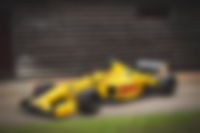
The Jordan Honda EJ12 made its debut at Silverstone on the 22nd of January 2002. Driven by Takuma Sato in front of engineers, mechanics, designers and Eddie Jordan, it was a month to the day before it was officially unveiled at a DHL hangar at Brussels airport, a move prompted by the team’s new principal sponsor in a deal said to be worth around £20,000,000 a season.
Originally planned to last three seasons, the DHL deal went sour as the EJ12 didn’t live up to its original promise, managing only one 6th position and four at 5th. However, despite racking up only 9 points at the end of the season, it is worth nothing that it performed much better than the identically powered BAR Honda, the other team to share the Honda RA002E engine.
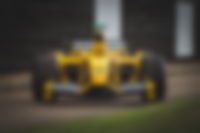
Designed by Eghbal Hamidy, it was a completely new design, albeit one based on the EJ11, the new carbon fibre monocoque was complimented by a theatrical aerodynamic package that included a dramatic front nose section as well as his trademark twin winglets that sit at the driver’s head level.
The all-new Honda RA002E engine was mated to a revised 7-speed Jordan transmission. Displacing three-litres and longitudinally mounted, the mid-engine is naturally aspirated and fed via Honda PGM fuel injection.
The front suspension comprises composite pushrods working to activate chassis-mounted Penske dampers and torsion bars, unequal length aerodynamic wishbones, composite top and bottom wishbones, fabricated uprights and a front anti-roll bar. The rear comes courtesy of more composite pushrods activating gearbox-mounted Penske dampers, unequal length aerodynamic wishbones, composite wishbones, fabricated uprights and an anti-roll bar.
Carbon discs and Brembo calipers are fitted all round, a wise choice given the engine’s 18,000rpm rev limit, 800bhp output, and 600kg weight. Sitting just 950mm high, the wheelbase is exactly three metres in an overall length of 4,600mm.
Oh, and it sits on OZ Racing wheels that were forged to Jordan GP specification.
An interesting insight into the development of a new F1 car was given when Tim Holloway, the project lead and Jordan’s head of engineering, detailed the lead times on various components. The longest lead times were for the chassis assembly and gearbox, which stretched for six weeks from the initial concept to actually being able to fit them on the car. Suspension uprights were said to take ten weeks, with a damper taking six – and even a rear pushrod or a brake duct took a month from drawing board to delivery.