

Background
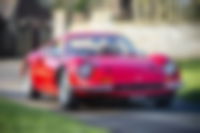
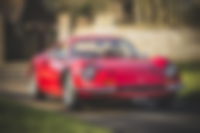
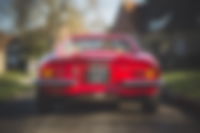
The Dino 206GT and the 246GT were relatively short-lived; only in production for the seven years between 1967 and 1974, the Dino might have been the first of the mass-produced Ferraris but its standing in the classic car far outweighs mere production numbers; if you subscribe to the theory that every Ferrari is special (and we do…) then the Dino holds a unique place in the hearts of those who know and love the marque.
The 206GT was the first to arrive. A two-litre V6-engined sportscar with ‘only’ 178bhp and 138lb/ft of torque, its aluminium body helped keep the weight down to a svelte 1,080kgs, something that helped endow the car with surprisingly sprightly performance.
It sounded wonderful as well, thanks to the three twin-barrel Weber carburettors. Reliable too, thanks to the Magneti Marelli electronic ignition, a new innovation for Ferrari and one that allowed owners to enjoy cars with an uncharacteristic degree of reliability.
But noise and reliability only go so far in creating a legend, and it was the independent suspension and all-round disc brakes that helped keen drivers make the most of every precious horsepower. With a top speed of 146mph only 157 were built, all of which were left-hand-drive.
The 246GT arrived in 1969. Fitted with a very slightly longer wheelbase and a more powerful 2.4-litre V6 engine, the new model developed 192bhp and 166lb/ft of torque. A very similar car to the 206GT it replaced, it gained just 20kgs in weight. And while the top speed remained the same at 146mph, the 0-50mph acceleration time was a very respectable 5.5 seconds.
Ferrari built 2,295 GT models, and 1,274 of the targa-topped Spider. The owner believes that 488 right-hand-drive 246GT Dinos came to the UK, but goodness knows how many have survived…
Interestingly, the Dino name was used as a sub-marque of Ferrari for a time and so doesn’t refer to any particular model. Enzo Ferrari’s son, Alfredo ‘Dino’ Ferrari, persuaded his father to produce a line of racing cars in the 1950s and ‘60s. Fitted with a variety of V6 and V8 engines, the script on the badge and cylinder head covers is his signature.
Dino Ferrari died in 1956 of Duchenne muscular dystrophy, and the range of cars that bears his name started with the Dino 156 F2 racing car that was fitted with the engine he is said to have helped design.
The first two road cars to bear his name were the 206GT and the 246GT we are discussing here, but the name was also used for the 308 GT4 until 1976, thereafter being badged simply as a Ferrari.