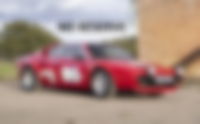
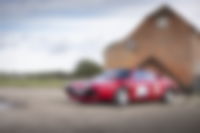
1977 Ferrari 308 Dino GT4 'Twin Turbo'

75 Bids
8:38 PM, 08 Nov 2021Vehicle sold
Sold for

£35,010

Background

Oh Lordy, it’s difficult following a stunning sibling. Launched in November 1973 the Dino 308 GT4 followed on from its 246 predecessor. Gone were that car’s sinuous curves, and Pininfarina too, as the company opted for Bertone’s very-of-the-time angular wedge profile.

Marcello Gandini’s lines put the new car in very good company; it’s aesthetics similar to a wide array of desirable machinery including Lancia’s Stratos, Lamborghini’s Urraco (both Gandini designs) and Lotus’ Esprit (Giugiaro, of course).

The car was notable too as Ferrari’s first ever 2+2, which saw it provide a fairly practical package. Allied to that was Maranello’s usual scintillating mechanical package; under the skin sat the company’s first ever V8 engine and it was a jewel – its 3-litres good for a very decent 230bhp.

Sales were a touch slow though, and in a bid to improve them the 308 became the first Dino to be afforded the Ferrari name. Meanwhile, over in Italy, punitive tax rules saw the introduction of a 1991cc turbocharged power unit.

Ferrari never turbocharged the 2926cc V8, but that’s not to say it’s never been done. It’s time to say hello to a ‘Twin Turbo’ race car, and a rather successful one at that.
  • 13894
  • TBC
  • 2926
  • Manual
  • Red
  • Black
  • Right-hand drive
Vehicle location
Bonhams|Cars Online HQ, United Kingdom

Background

Oh Lordy, it’s difficult following a stunning sibling. Launched in November 1973 the Dino 308 GT4 followed on from its 246 predecessor. Gone were that car’s sinuous curves, and Pininfarina too, as the company opted for Bertone’s very-of-the-time angular wedge profile.

Marcello Gandini’s lines put the new car in very good company; it’s aesthetics similar to a wide array of desirable machinery including Lancia’s Stratos, Lamborghini’s Urraco (both Gandini designs) and Lotus’ Esprit (Giugiaro, of course).

The car was notable too as Ferrari’s first ever 2+2, which saw it provide a fairly practical package. Allied to that was Maranello’s usual scintillating mechanical package; under the skin sat the company’s first ever V8 engine and it was a jewel – its 3-litres good for a very decent 230bhp.

Sales were a touch slow though, and in a bid to improve them the 308 became the first Dino to be afforded the Ferrari name. Meanwhile, over in Italy, punitive tax rules saw the introduction of a 1991cc turbocharged power unit.

Ferrari never turbocharged the 2926cc V8, but that’s not to say it’s never been done. It’s time to say hello to a ‘Twin Turbo’ race car, and a rather successful one at that.

Video

Overview

This very interesting beast is the well-known ex-Tony Lambert Ferrari 308 Dino GT4, which he campaigned successfully during the Nineties. Highlights include overall winner in the 1993 RAC MSA Hillclimb Leaders Championship, with a class win the following year; a class win at the 1993 Pound Timber Midland Championship and class records at Prescott (short and long courses), Loton Park, Wiscombe, Doune and many others.

Its specification includes:

Twin Janspeed turbos and charge cooling

Lightweight bodywork

And split rim alloy wheels

Full roll cage

Sabelt seats

Willans harnesses

OMP fire extinguishers

Vendor Pete Tinton bought the car from Tony Lambert himself in February of this year. “It was with a view to doing some hill climb events, but this has unfortunately been curtailed due to health problems so it’s up for sale. It’s worth noting that the car is road legal; Tony kept it MoTd, although the last one has only just lapsed – in August this year.”

Shortly after purchasing it, Pete had the GT4 recommissioned at North Leach-based Ferrari specialist Bob Houghton. “This cost in the region of £12,000 and included new seats, harnesses and fire extinguishers. The engine was serviced, shock absorbers reconditioned, and new brake pads and tyres fitted.”

Those works mean that the car is absolutely ready for action, be that hill climbs, sprints or track days.

Exterior

The GT4 outline has never looked better than it does here emblazoned with decals and with wild Group 4-esque wheelarches. The latter lend it a purposeful stance; something that’s further enhanced by the twin exit exhaust pipes, split rim alloy wheels and front-mounted Cibie spotlights. In period glass fibre units replaced the doors, and front and rear compartment covers – and the car still proudly sports them.

“Those spotlights can be removed for track events,” says Pete. “And I still have all the original steel panels, apart from one door. These items are included in the auction sale, but he says he has to dig them out of his owrkshop.

"The bodywork does carry trophies of its exploits.” he concludes.

That means there are one or two scrapes and scuffs here and there such as the deep scuff on the offside edge of the custom front valance (all can be viewed in our Photographic Gallery, below), but that simply lends this race car a genuine patina and one that’s been earned the hard way.

Motor engineer Manuel A.J. Queroz developed the car with Tony Lambert during the Nineties and the body has many adaptations, including stainless steel air intakes on the three quarter panels and vertical indicators and sidelights on that front valance.

The five-star split-rim alloy wheels sport brand new and unused Toyo Proxes R888R tyres.

There’s no doubt it’s a striking thing.

Interior

There are no niceties inside this little Dino – the cabin is pure race car. The lightweight glass fibre doors operate via pull cords, a full roll-cage is fitted and as stated, the Sabelt seats, Willans harnesses and OMP fire extinguishers are all new.

An electrical cut-off sits just to the left of the steering wheel within easy reach of the pilot; the fuse box is dashboard mounted for ease of access and there’s a tres funky and tactile #7 Red pool ball gearknob fitted. The rev counter also sits at a jaunty race car angle to aid you as you hit the throttle, as does a gearshift light on the dash top.

The seat/harness combo holds you in tighter than a carbon fibre weave. Crank up the Quattrovalvole V8, blip the throttle and the deep twin exhaust note reverberates through the cabin (more on that, below).

One thought comes to mind: this is going to be fun.

Mechanical

“The car is definitely an experience to drive,” says Pete. “With a howling V8 behind your seat and a turbocharger per bank of cylinders!” That’s perhaps one of the understatements of the year, because it’s a wild, wild thing.

The V8 pulls like a juggernaut, turbochargers sounding like a thoroughbred stallion whilst carrying out their ablutions to propel you forward. The click-clack of the open gate is pure Ferrari and a vital part of the experience; cogs shift easily with a firm hand and the up-rated brakes are fierce. The wide rubber swallows corners whole.

Peer underneath and you’ll see that alloy under trays have been fitted to aid aerodynamics. It also reveals a touch of surface rust and paint peeling on the very bottom edge of the sills, so the next owner may wish to tidy these up.

The Janspeed work on the car during the Nineties included sump and pick-up mods, fitment of a large capacity oil tank and a purpose-designed FT3 bag tank, twin high-pressure fuel pumps, twin hybrid Garrett t25 turbochargers and Zytek fully sequential mapped ignition.

The paperwork from Janspeed refers to 400bhp!

History

The car comes with a lovely history file including a printout of the full specifications of the modifications made by Janspeed (at a cost of £11,677.50 on 14/02/91) and mentioned in the ‘Underneath’ section above (excuse the contradiction, there!).

You’ll also find a number of press clippings from Mr Lambert’s various hillclimb exploits, a variety of invoices, expired MoT test certificates and the original handbooks. In addition there is a handwritten notebook detailing all of the car’s service history from its competition life and a couple of DVDs of the car racing in period.

The V5C document is included and shows that the Dino has had a total of eight keepers during its life.

Please visit the documents section of the gallery of this listing where you will find photos of the paperwork to support our claim that this race car has been built and then maintained to the very highest of standards.

Summary

Building a race car is never a cheap enterprise and when you come to sell, you’re only likely to recoup a fraction of the costs; the good news here, is that it’s already been done for you. In fact, it’s not just a decent race car that’s on offer here it’s a championship-winning one.

Okay, so those glories stand in the past but there’s no doubt that it’s a proven piece of kit. Vendor Pete has carried out a comprehensive recommissioning at a renowned Ferrari specialist, but ill health unfortunately means he’s unable to use it and so it’s now up for sale.

The next owner will receive a fine race car in tip-top condition. We think that they’ll have to pay somewhere in the region of £25,000 to £45,000 for the privilege. That’s quite a big range, but race cars are notoriously difficult to price.

One thing’s clear, whoever buys it is going to have a ball with this car. It can be used as is, or further developed to improve its competitiveness. Remember, old race cars never retire – they get fettled and go again.

Viewing is always encouraged and as stated this car is located at THE MARKET headquarters near Abingdon; we are open Mon-Fri, 9am-5pm and to arrange an appointment please use the ‘Contact Seller’ button at the top of the listing. Feel free to ask any questions or make observations in the comments section below, or try our ‘Frequently Asked Questions’.

About this auction

Seller

Private: tints1


Viewings Welcome

Viewing is strongly encouraged, and is strictly by appointment. To book one in the diary, please get in contact.

14191c31-73df-4c6f-bc7b-4507e21315a8/preview-fd5b2a42-864b-4dbc-bd9e-253d742007aa.jpg?optimizer=image&width=650&quality=90 image

Thinking of selling your Ferrari